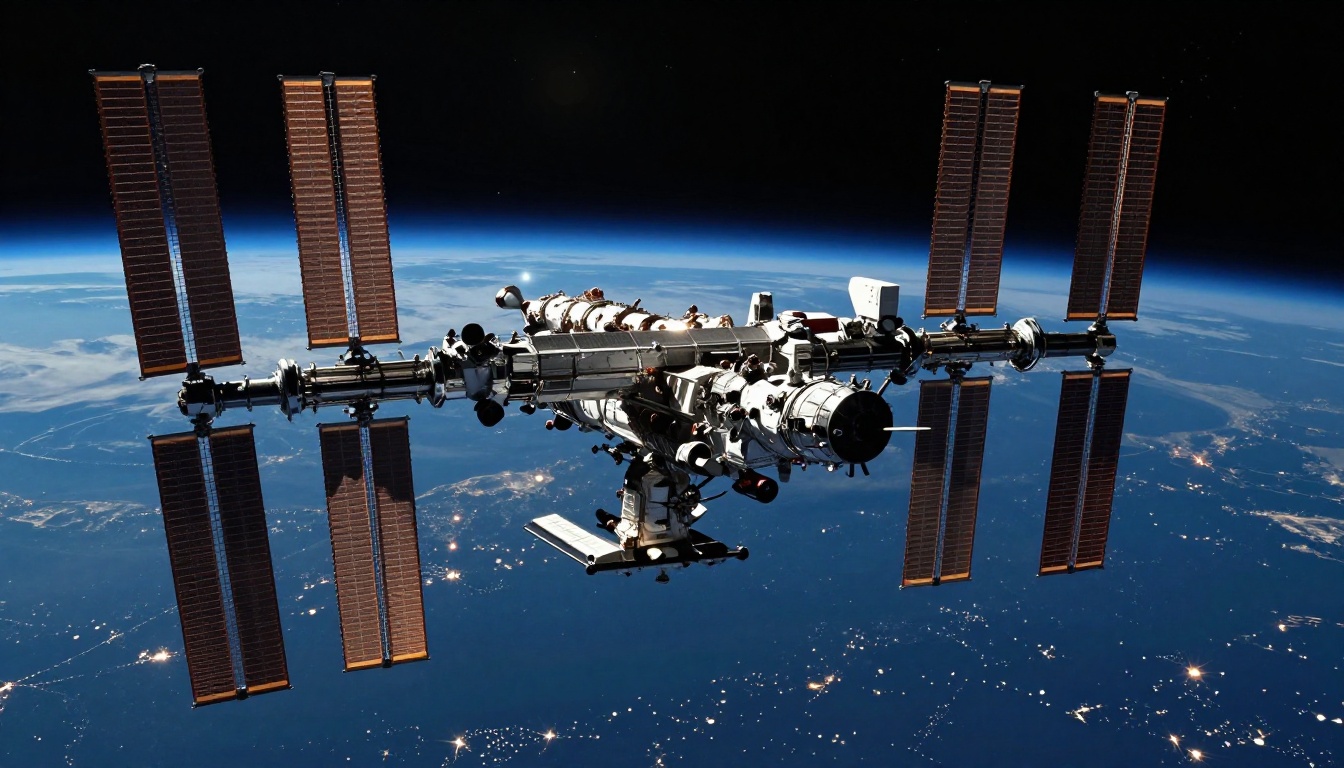
The International Space Station zips around Earth at 17,500 miles per hour. It completes 16 laps each day. Yet it never falls.
This feat comes from a precise balance between speed and gravity. Space stations stay in orbit because they fall toward Earth while moving fast enough sideways to miss it. But thin air drag pulls them down slowly. Crews fight back with regular boosts.
As of March 2026, the ISS orbits at 421.54 kilometers up after a recent lift from a Progress ship. It will run until 2030 before a planned deorbit. China’s Tiangong station faces similar issues. You will learn how these giants defy gravity and what comes next.
The Magic Balance: Speed and Gravity That Keeps Orbits Going
Gravity pulls everything down. Drop a ball, and it falls straight. But imagine firing a cannonball fast enough sideways. It curves around Earth instead of hitting the ground. Isaac Newton pictured this long ago.
Space stations work the same way. They hurtle forward at 17,500 miles per hour, or 7.8 kilometers per second. Gravity bends their path into a circle. For more on this, check Space.com’s explanation of ISS orbits.
Astronauts feel weightless because the station free-falls constantly. Everything inside falls too, at the same rate. No one floats lazily. They all plummet together around the planet.
Low Earth orbit sits 250 to 400 kilometers high. Here, gravity stays strong enough to hold the curve tight. Higher up, pulls weaken. Speed needs drop then. But low spots suit human visits. Shuttles reach them easiest.
Why Altitude Matters for That Perfect Speed
Altitude sets the speed rule. At 400 kilometers, gravity demands that 17,500 miles per hour clip. Go slower, and the station dips into thicker air. It loses height fast.
Too quick, and it climbs away. The path turns oval. Teams aim for circles. The ISS holds about 415 kilometers now, perfect for docks and views.
Higher orbits need less rush. Geostationary ones at 35,786 kilometers match Earth’s spin. Satellites there hover over one spot. But stations stick low for easy access. Besides, high spots cost more fuel to reach.
Changes matter little day to day. A 1 kilometer slip feels tiny. Yet it adds up. Speed ties straight to height. Teams watch close.
One Orbit, 90 Minutes: A Day in the Life of a Space Station
One loop takes 90 minutes. The ISS crosses dawn 16 times daily. Crews see sunrises every 45 minutes. Black space flips to blue Earth, then back.
At 28,000 kilometers per hour, views stun. Oceans gleam. Cities sparkle at night. Clouds swirl like cotton.
Speed stays constant without drag. But air rubs. Still, that velocity keeps the balance. Astronauts train for this rhythm. Sleep shifts match the cycles. Day feels odd up there.
The Hidden Drag That’s Always Trying to Pull Them Down
Earth’s atmosphere thins out high up. Yet traces linger in the thermosphere. They hit the ISS like a breeze on a race car.
Drag slows the station 2 inches per second. It drops 300 to 350 feet daily. Without fixes, orbit decays in one to two years. The ISS loses 2 kilometers monthly now.
Solar activity heats air. It puffs up. Drag worsens then. Teams track it close. Space junk adds risk. Stations dodge bits often.
For a quick take on this pull, see Britannica’s ISS orbit facts.
How Drag Builds Up Over Time Without Fixes
Loss snowballs. Lower height means denser air. Drag bites harder. Speed drops more. The spiral quickens.
The ISS weighs 430,000 kilograms. Big solar wings catch air like sails. They boost drag. Crews trim them sometimes.
No action spells doom. Early stations like Mir fell without boosts. Debris rained down. Modern ones act smart. Drag never wins alone.
Boosts and Thrusters: The Lifelines Keeping Stations Aloft
Reboosts happen every one to two months. Docked ships fire engines. Russia’s Progress leads often. Northrop Grumman’s Cygnus helps too. It tested longer burns in 2025.
On March 13, 2026, Progress MS-32 raised the ISS 1.1 kilometers. It fired 634.7 seconds for a 0.62 meters per second kick.
Zvezda module thrusters back them up. A US deorbit tug comes in 2028. It guides the end plunge to the Pacific by 2030.
Ion thrusters save fuel. They glow blue and push steady. Future stations love them. Learn about Cygnus reboosts at Northrop Grumman’s update.
Old-School Chemical Burns vs. New Ion Thruster Tech
Chemical rockets blast hard and quick. Progress packs them for big lifts. They guzzle fuel but work fast.
Ion thrusters sip instead. They ionize gas and fling it out. Hall-effect types on Tiangong run 8,000 hours. Fuel use drops 90 percent.
Tiangong holds 400 kilometers steady with them. No big drama. Chemicals suit emergencies. Ions handle routine.
From ISS to the Future: How Other Stations Handle Orbits
The ISS winds down post-2030. Commercial ones rise. Tiangong runs now at 340 to 450 kilometers. It uses module thrusters for tweaks.
Axiom starts 2027 with ISS add-ons. It detaches by 2028. Starlab launches whole on Starship in 2028. Orbital Reef plans modules in 2027. All aim low Earth orbit, 400 to 500 kilometers.
Trends shift to electric drives. AI aids upkeep. Auto-docks cut crew tasks. Free-flyer tugs boost from afar.
Tiangong’s Smart Tricks Already in Action
Tiangong orbits 389 to 399 kilometers typical. Thrusters on Tianhe, Wentian, and Mengtian keep it so. No big March 2026 news, but routine fires counter drag.
Magnetic shields protect engines. Starfish-like AI robots fix leaks. The Xuntian telescope joins soon in co-orbit. Taikonauts stay months easy.
Commercial Stations Gearing Up with Next-Gen Tech
Axiom builds Payload Power Thermal Module now. Starlab mocks up full-size. Orbital Reef tests inflatables.
They pack electric propulsion built-in. Tugs handle boosts. Inflatable parts adjust shape for less drag. Robots arm up for junk dodges.
| Station | Key Orbit Tech | Launch Target |
|---|---|---|
| Axiom | Electric tugs, modular adds | 2027+ |
| Starlab | Integrated electrics, Starship | 2028 |
| Orbital Reef | Advanced thrusters, inflatables | 2027 modules |
These cut costs. Crews focus science, not pushes.
Speed and gravity form the base. Drag fights need boosts and thrusters. The ISS proves it for decades.
Commercial hubs usher a busy low-Earth era. Watch ISS passes with apps. Share your picks for the next big station. Humanity’s orbit hold grows stronger.