
Astronomers spot galaxies billions of light-years away using telescopes right here on our planet. Yet Earth’s atmosphere blurs that view like heat waves over a hot road. It blocks key wavelengths too.
You might wonder how they pull off sharp images of stars and planets anyway. Scientists use powerful ground telescopes, smart fixes for air distortion, and extra tools to decode signals. This post breaks it down simply. You’ll see real methods behind studying space from solid ground.
Why Earth’s Air Turns Stargazing into a Puzzle
Stars twinkle because hot and cold air pockets bend their light. That’s turbulence at work. It smears images from optical scopes the same way.
Our atmosphere soaks up ultraviolet rays, X-rays, and gamma rays completely. Infrared light struggles too because water vapor grabs it. Radio waves, however, zip through with little hassle. That’s why radio astronomy thrives on Earth.
City lights fade over distance for the same reason: air scatters and absorbs them. Mountains help a bit with thinner air. Space avoids the issue entirely. Still, ground setups cost less and stay easier to maintain. They deliver steady data streams as a result.
Turbulence limits resolution to about one arcsecond on good nights. That’s like reading fine print from a football field away. Observations suffer without fixes. Next, see how basic telescopes fight back.
Ground Telescopes Bringing Distant Worlds into Focus
Big mirrors and lenses collect faint starlight despite the air mess. Reflectors dominate because they avoid lens weight issues. They bounce light to focus points for crisp views.

Optical Telescopes Grabbing Starlight and Galaxy Views
Keck’s twin 10-meter mirrors catch light from far-off galaxies. Refractors bend light through glass, but they sag under size. Reflectors use curved mirrors instead. They excel at visible wavelengths for everyday sky mapping.
These scopes spot supernova explosions and measure cosmic expansion. Teams share time on them for broad studies. Ground-based ones like those at Schools’ Observatory explain basics well. They pack power for routine work.
Radio Telescopes Tuning into Universe Radio Waves
Giant dishes like the HERA array in South Africa listen for early universe echoes. Radio waves ignore most air trouble. Arrays link dishes to mimic huge single ones.
They detect black hole jets and spinning pulsars. Signals reveal hydrogen clouds from cosmic dawn. No domes needed; open fields suffice. Golden-hour views highlight their scale.

Infrared Telescopes Spotting Heat from Dusty Space
Near-infrared scopes on high peaks pierce some dust clouds. Atmosphere cuts deeper infrared, but dry sites help. They reveal star nurseries hidden in gas.
Compare to space giants like JWST; ground versions complement them cheaply. Examples include warm protostars glowing through veils. Mountains boost their edge.
Clever Fixes to Sharpen Views Past the Atmosphere
Humans outsmart air with tech tweaks. These boost clarity without launching gear skyward.

Adaptive Optics Smoothing Out Air Wobbles
Lasers shoot fake guide stars above the air. Sensors track their wobble. Deformable mirrors flex thousands of times a second to match.
Think shaky handheld video steadied in post. Keck and upcoming ELT use this. It delivers Hubble-like sharpness from ground. Gemini systems show it in action.
Mountain Observatories Climbing Above Thick Air
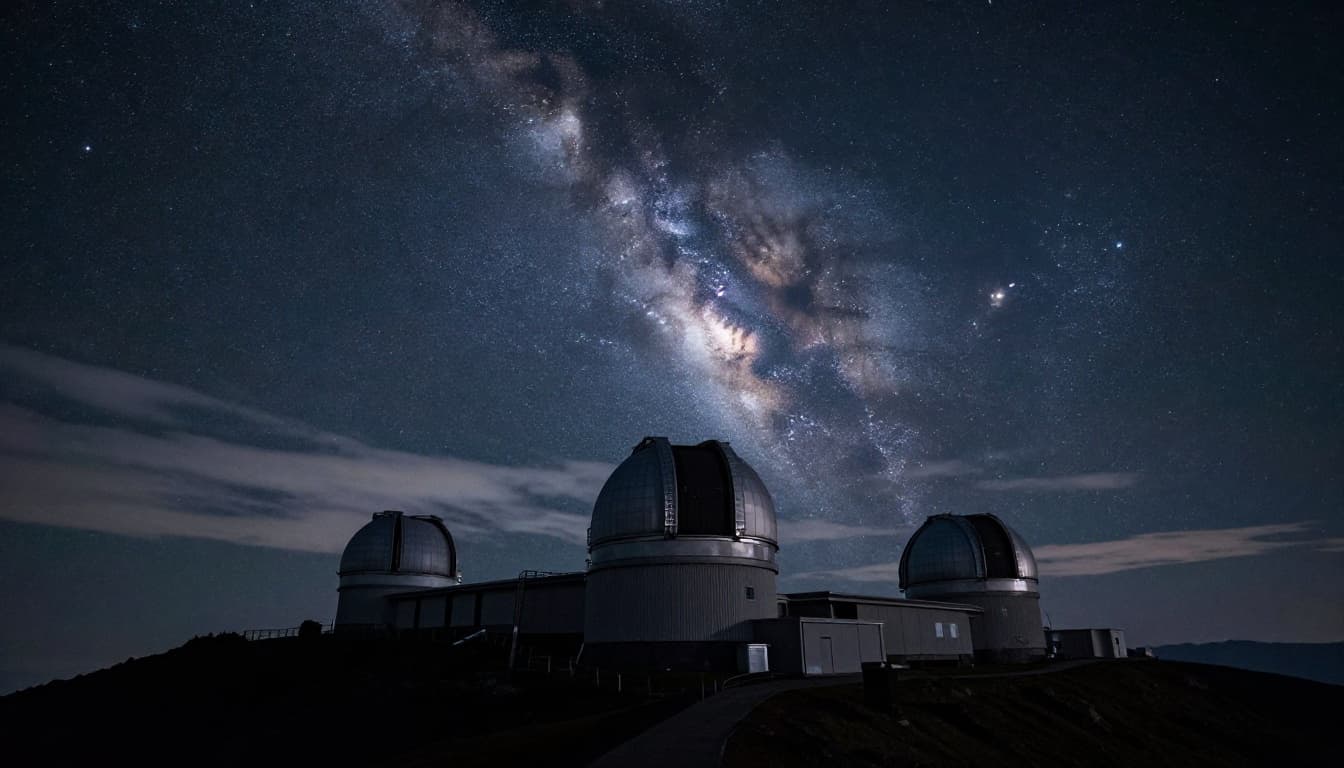
Mauna Kea in Hawaii tops 13,000 feet with steady winds. Atacama Desert in Chile stays bone-dry year-round. Less vapor means clearer infrared paths.
Thinner air cuts turbulence too. Sites like these host twin Kecks or ALMA arrays. Benefits stack: colder nights preserve faint signals. No wonder they cluster there.
Special Tools Decoding Space’s Hidden Messages
Telescopes pair with analyzers for richer data. These unpack light and signals smartly.
Spectroscopy Splitting Light to Reveal Star Stuff
Prisms split starlight into rainbows. Lines mark elements like hydrogen or iron. Shifts show speed via Doppler effect.
Ground scopes handle visible and radio spectra fine. They ID exoplanet gases or star ages. Simple yet powerful for composition reads.
Interferometry Linking Telescopes for Razor-Sharp Images
Scopes miles apart sync as one big eye. Light waves combine for fine detail. Event Horizon Telescope snapped black hole shadows this way.
Radio versions map star surfaces. Optical ones hunt exoplanets. Resolution beats single dishes easily.
Radar Astronomy Bouncing Signals Off Nearby Worlds
Dishes ping radio waves at Venus or asteroids. Echoes give distance, spin, and shape. Clouds don’t block them.
Arecibo pioneered this before its collapse. It mapped Mercury’s ice. Legacy details inspire new efforts.
2026 Breakthroughs Supercharging Earth-Based Space Study
ELT’s dome nears completion in Chile’s Atacama. At 70% done this March, its 39-meter mirror preps for 2027 install. First light hits in 2029.
It gathers 13 times more light than current leaders. Adaptive optics sharpen exoplanet atmospheres for life hints. ELT previews build hype.
HERA pushes cosmic dawn studies with hydrogen signals. Early data from MIT reports teases first stars. Low-frequency arrays fight city noise for quiet views.
Moon plans add radio quiet zones soon. These tools promise black hole maps and galaxy births.

Ground methods unlocked black hole photos and exoplanet clues. Telescopes, air fixes, and decoders make it happen. Earth stays prime for space study.
Grab binoculars for local stars tonight. Tour virtual scopes online. What’s your favorite sky wonder? Space calls from right under our feet.