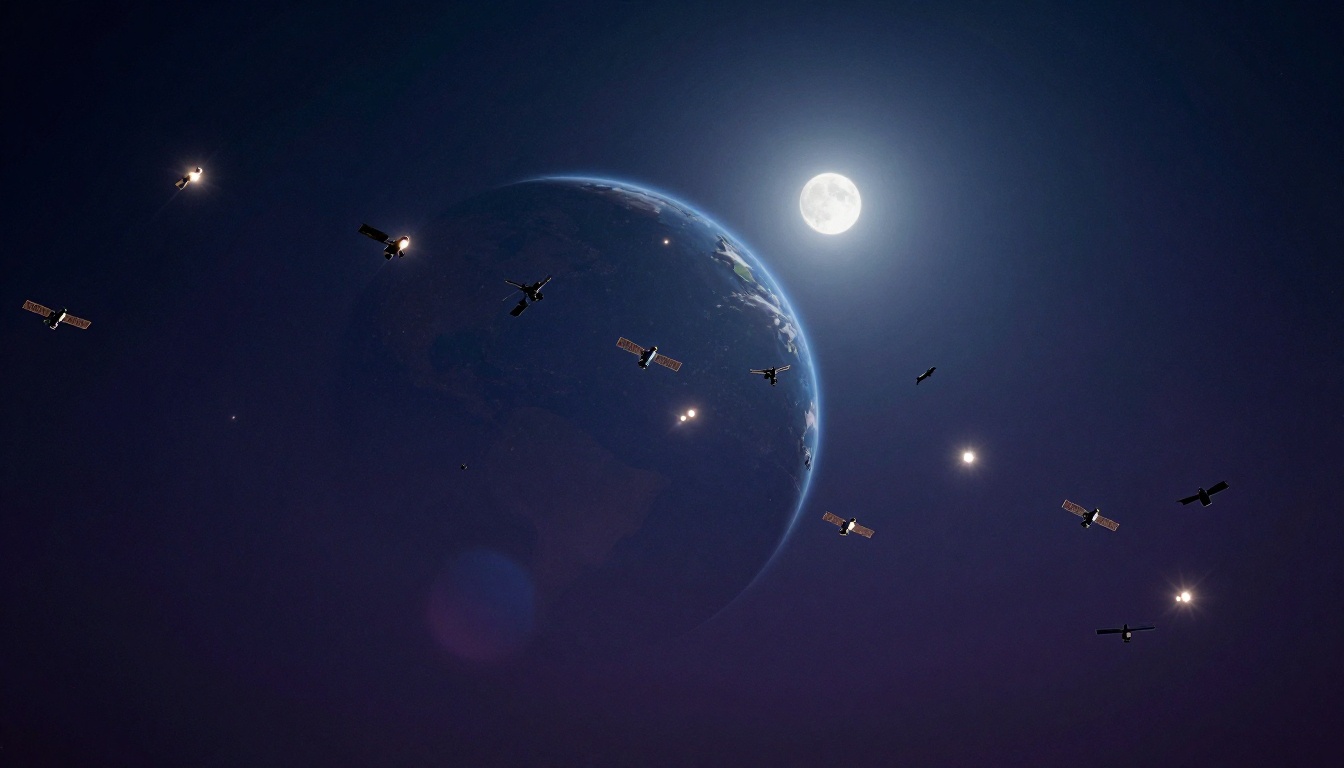
You grab your phone for directions during a road trip. Or you check the weather app before heading out. These simple acts rely on satellites circling high above Earth.
Satellites are objects that orbit larger bodies like our planet. The Moon counts as a natural one. Humans build artificial versions for key tasks.
This post breaks down what satellites are, how they work, their types, and their huge role in daily life. Right now in March 2026, over 12,000 active ones fill the skies. They connect us and keep watch in ways we depend on every day.
What Exactly Defines a Satellite?
Satellites follow a clear rule. They orbit a bigger object due to gravity’s pull. Earth has one main natural satellite, the Moon. It pulls on oceans to create tides. At night, it lights our way.
Artificial satellites change the game. People design and launch these machines for jobs like sending signals or snapping photos. Thousands buzz around now. For a solid definition from experts, check out NASA’s explanation of satellites.
We need them because they handle tasks too tough for ground tools. They spot storms from space or guide ships across oceans. Next, we’ll spot the main differences.
Natural Versus Artificial: Spotting the Difference
Natural satellites form on their own. Think of the Moon as a giant space rock caught in Earth’s gravity. Other planets have moons too. These bodies just exist, untouched by humans.
Artificial satellites pack tech instead. Engineers build them, load rockets, and fire them up. Picture natural ones like wild deer roaming free. Artificial ones act like loyal dogs fetching what we need.
The Moon affects us daily with tides. But artificial satellites do more active work. They relay your calls or track weather shifts.
The Building Blocks of Artificial Satellites
These machines look like high-tech toolboxes in space. Solar panels catch sunlight for power. They unfold like wings after launch.
Antennas send and receive signals. Cameras or sensors grab data on land or air. Small thrusters nudge them to stay on path. Without these parts, they’d drift useless.
Solar panels keep them running for years. Sensors spot changes on Earth below. Thrusters save fuel for long missions.
How Do Satellites Launch and Stay Up There?
Rockets kick things off. They blast satellites to 17,000 miles per hour. At that speed, gravity curves their path into a circle. They fall around Earth without crashing.
Once up, they circle in orbits. Ground stations catch their signals. Then computers process the info for us. Launches feel like space adventures. Reusable rockets from companies like SpaceX cut costs now.
Signals bounce from satellite to station. Orbits decide their jobs. Low ones zip fast for internet. High ones hover steady for TV.
Rocket Launches and Orbit Magic
Rockets fight gravity first. They burn fuel to climb high. Then they release the satellite at top speed. It deploys panels and starts work.
Reusable boosters land back for reuse. SpaceX flies some 34 times now. This drops prices. More satellites go up because of it.
The magic happens in balance. Speed fights gravity’s tug. Result? A steady loop around Earth.
LEO, GEO, and Other Orbit Types Explained
Low Earth Orbit sits 100 to 1,200 miles up. Satellites lap Earth fast, twice a day. They suit internet or spy work because signals travel quick. For details on these paths, see this guide to LEO, MEO, and GEO orbits.
Geostationary Orbit towers at 22,000 miles. Here, satellites match Earth’s spin. They stay fixed over one spot. Perfect for TV broadcasts.
Medium orbits fall in between. Each type fits a job. LEO needs boosts against air drag. GEO offers wide views.
Exploring the Main Types of Satellites in Action
Satellites split into groups by task. Communications ones relay TV and calls. Navigation types like GPS pinpoint your spot. Weather satellites forecast storms. Earth observers map changes. Scientific ones probe deep space.
Each type solves real problems. They beam data worldwide. Without them, planes stray and farms guess crop yields.
Communications Satellites: Bridging Global Gaps
These handle phone chats and internet over oceans. Signals hop from one to ground dishes. Remote villages get online thanks to them.
They cross borders easy. Ships and planes stay linked. In tough spots, they replace cables.
GPS and Navigation: Your Phone’s Best Friend
Twenty-four GPS satellites circle for location fixes. Your phone pings them for maps. Cars reroute traffic. Deliveries hit doors exact.
Pilots and hikers depend on it. Accuracy reaches yards. No more lost trips.
Weather Watchers and Earth Scouts
Weather satellites eye clouds from afar. They predict hurricanes days ahead. Alerts save lives and homes.
Earth scouts snap land photos. They track fires, floods, or farm health. Governments watch climate shifts this way.
Why Satellites Power Our Everyday Lives
Satellites touch everything. You use GPS for drives. Satellite TV streams shows. Weather apps warn of rain. They make life smoother.
Disasters hit less hard because of early alerts. Farmers boost harvests with crop views. Businesses connect global teams. For more on their daily impact, read this overview of satellites in everyday life.
Over 12,000 active ones serve us now. They enable smartphones and safe flights.
From Phone Maps to Disaster Alerts
Maps guide your commute. Packages arrive on time. Weather spots tornadoes early. Evacuations start fast.
Rural folks get forecasts too. Lives stay safe because of quick data.
Connecting the World and Boosting Economies
Internet reaches islands now. Remote workers join calls. Ships track routes better.
Trade flows smooth. Jobs grow in far spots. Economies link tight.
Satellites Now: Explosive Growth and What’s Next
March 2026 shows a boom. About 12,149 active satellites orbit Earth. SpaceX launched 865 in early months alone. Starlink leads with over 10,000.
Mega groups like it blanket the planet. Users hit 10 million. Launches happen weekly. Space junk worries rise though.
Future brings phone-direct service. Laser links speed data. Swarms could top 100,000 by 2030.
Starlink and the Rise of Mega-Networks
Starlink packs thousands in LEO. Small satellites deliver fast internet everywhere. Planes, ships, and homes connect.
Growth exploded since 2019. Now it serves remote users best. For updates on its 2026 expansion, check recent reports.
Subscribers top 10 million. It changes who gets online.
Challenges Ahead and Cool Future Tech
Too many satellites risk crashes. Junk piles up. New tools clear debris.
Better images come soon. CubeSats go cheap. Swarms team for big tasks.
Satellites keep our world linked and informed. From basic orbits to mega networks, they handle vital jobs. GPS guides you, weather protects, comms connect.
Next time you use maps or check skies, think of them. Look up tonight. Spot a streak? That’s one at work. Stay tuned for more space updates.
(Word count: 1,482)