
Look up at a clear night sky. Those faint fuzzy patches aren’t clouds. They mark entire cities of stars, each a galaxy packed with millions to trillions of stars, gas, dust, and dark matter. Gravity binds them into vast systems that stretch thousands to millions of light-years across.
Our home, the Milky Way, fits this picture. It spans about 100,000 light-years and holds around 200 billion stars. You live inside one arm of this barred spiral galaxy. But galaxies come in different shapes. Astronomers group most into three main types based on Edwin Hubble’s classic system: elliptical, spiral, and irregular.
Why care about these types? Shapes reveal how galaxies form, grow, and change over billions of years. Ellipticals look smooth and old. Spirals swirl with fresh stars. Irregulars seem chaotic. Think of them as family members at a cosmic reunion, each with a unique story. Knowing them helps unlock the universe’s history, from wild mergers to quiet aging.
Galaxies cluster too. Ours sits in the Local Group with neighbors like Andromeda. Recent telescopes like James Webb spot even older ones, but the core types hold firm. So, what exactly makes a galaxy tick? Let’s break down its parts next.
What Holds a Galaxy Together: Stars, Gas, Dust, and Invisible Forces
Stars form the bright backbone of any galaxy. Billions or trillions shine at once, like lights in a sprawling metropolis seen from space. But stars alone don’t hold it all. Clouds of gas and dust fill gaps. These raw materials birth new stars in bright nurseries.
Gas often glows pink from hydrogen. Dust blocks light, creating dark lanes. Together, they fuel ongoing creation. Yet something invisible rules the show: dark matter. It provides extra gravity, or the whole system flies apart. Scientists infer it from how stars orbit too fast without crashing.
Galaxies vary in size. Dwarf ones pack just millions of stars across a few thousand light-years. Giants boast trillions over a million light-years. Our Milky Way sits in the middle. It spins once every 240 million years. That’s slow; one trip around takes longer than human civilization exists.
Most galaxies join groups. Gravity pulls them close. The Local Group has over 50, including the Milky Way and Andromeda. At centers, supermassive black holes lurk. Sagittarius A* anchors ours, with four million solar masses. These beasts shape gas flows and star birth.
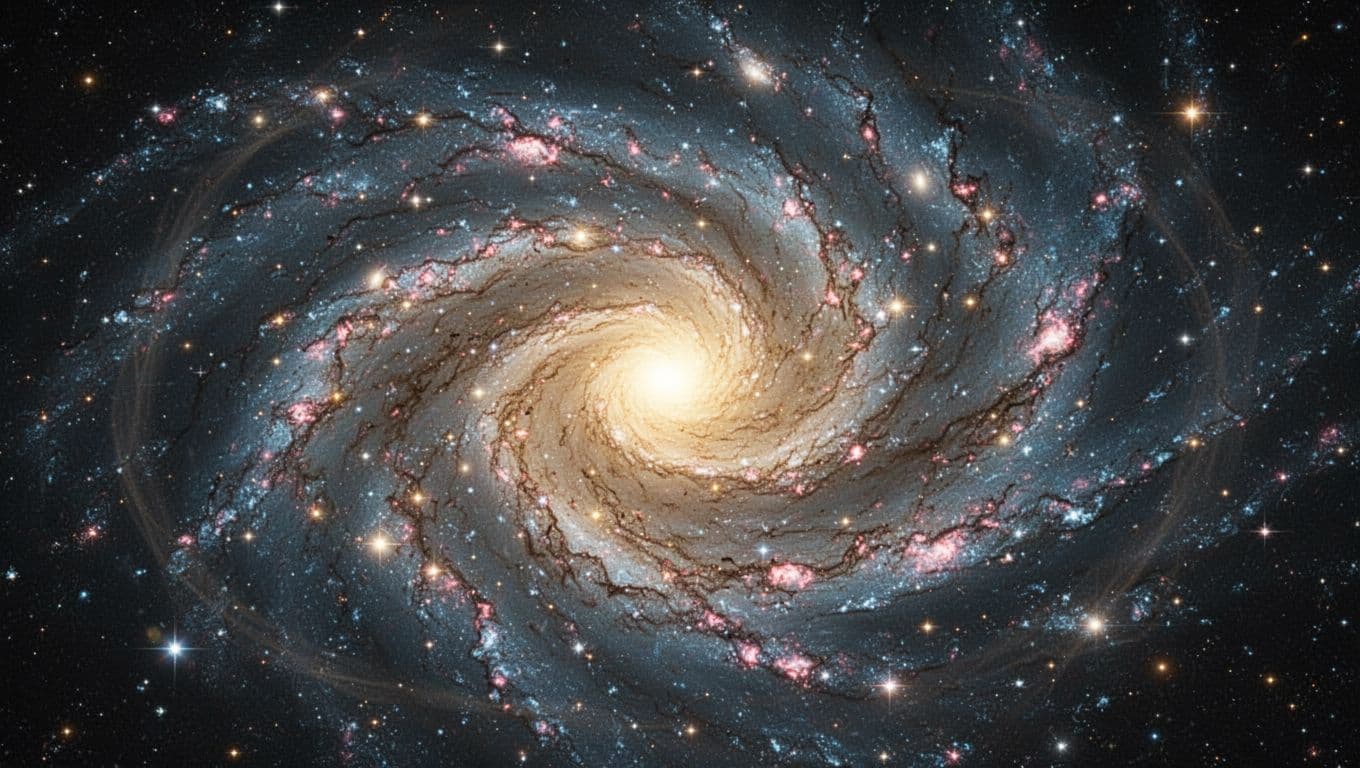
This image captures a typical spiral’s layers. The yellow bulge holds old stars. Blue arms pulse with youth. Dark matter’s halo stretches faint around the edge.
In short, stars light the way, gas and dust build the future, and dark matter glues it firm. Without this mix, no galaxies form. Next, see how shapes define the main types.
The Three Main Galaxy Types: From Smooth Eggs to Swirling Arms
Edwin Hubble set the standard in 1936 with his “tuning fork” diagram. It sorts galaxies by shape, from smooth ellipticals to swirling spirals and messy irregulars. This system endures because shape ties to age, star formation, and history. Lenticulars bridge spirals and ellipticals, but the big three dominate: elliptical, spiral, irregular.
| Type | Shape Features | Star Formation | Common Locations |
|---|---|---|---|
| Elliptical | Oval or round, smooth glow | Low (old stars) | Galaxy clusters |
| Spiral | Disk with arms, central bulge | High in arms | Field or groups |
| Irregular | Lumpy, no clear structure | Active | Near larger galaxies |
This table sums key traits. Shape affects everything. Smooth ones quit making stars. Swirly disks keep going. Odd shapes signal disruptions. For details on Hubble’s full scheme, check Galaxy Classification from Las Cumbres Observatory.
Now, dive into each.
Elliptical Galaxies: Calm, Ancient Star Collections
Ellipticals resemble eggs or footballs. They glow even without arms. Old red stars dominate, numbering billions to trillions. Little gas or dust remains, so new stars rarely form.
Sizes range wide. Dwarfs fit in clusters. Giants like M87 span millions of light-years. That one hosts a famous black hole imaged in 2019. Mergers create them. Colliding spirals lose arms and smooth out.
Picture a quiet retirement village. Stars age peacefully. No kids running around. Yet these hold the most mass in clusters.
Spiral Galaxies: Bright Arms Bursting with New Stars
Spirals feature a flat disk, bulging center, and winding arms. Young blue stars dot arms, mixed with gas clouds. Dust lanes wind dark paths. The bulge packs older yellow stars.
Subtypes vary. Sa spirals have tight arms and big bulges. Sc types show loose, open arms. Barred spirals like ours add a central bar. It funnels gas to the core.
The Milky Way measures 100,000 light-years wide. Sagittarius A* sits at heart. Andromeda, our biggest neighbor, heads our way. It’ll collide in four billion years, but stars pass harmlessly.
Arms act as star factories. Gravity triggers bursts there. Think pinwheel cookies, dough swirling with colorful bits.
Irregular Galaxies: Messy Shapes from Cosmic Tugs
Irregulars lack order. They lump and twist without disks or arms. Interactions warp them. Gas abounds, sparking lively star birth.
Most stay small, dwarf-sized. The Magellanic Clouds orbit the Milky Way as examples. They trail gas tails from our pull.
Like a train wreck caught mid-chaos, these reshape fast. Yet they fuel fresh stars. Gravity’s tugs keep them dynamic.
Real-World Examples and Fresh Discoveries in Galaxy Science
Our Milky Way exemplifies spirals. A bar stretches through center, arms spiral out. It holds 100 to 400 billion stars. Dark matter halo envelops it all. The Local Group binds us with Andromeda and 50 others. Andromeda outshines us, twice the width at 220,000 light-years. Gravity draws it closer at 250,000 miles per hour.
Groups like ours form superclusters. Mergers drive evolution. Spirals crash, birth ellipticals. Irregulars twist from close encounters. For a map of our neighborhood, see Local Group details on Wikipedia.
James Webb Space Telescope adds excitement. As of March 2026, it spots early galaxies too mature for their age. One barred spiral, COSMOS-74706, formed two billion years post-Big Bang. That’s spiral structure way ahead of schedule. No new types emerge. These fit Hubble classes but challenge timelines.
JWST found mergers at 800 million years old, like “JWST’s Quintet.” Five galaxies smash, spewing stars at 250 suns per year. Another, a “jellyfish” galaxy, trails gas tentacles through a cluster. Ram pressure strips it, 8.5 billion years back. Dusty dwarfs from 500 million years show quick growth.
Early finds like MoM-z14 at 280 million years glow with nitrogen, mimicking old locals. Hydrogen light pierced the cosmic fog sooner than thought. All reinforce the three types. Bars, disks, clumps evolve fast via mergers.
Imagine our future smash with Andromeda. It’ll form a new elliptical, stars dancing through. JWST views, like a recent spectacular spiral, wow us. Check JWST’s most distant red galaxy report for latest.
These insights update models. Galaxies grew turbulent early on.
Galaxies define our cosmos. A galaxy means stars, gas, dust, and dark matter under gravity’s grip. Hubble’s three types, elliptical, spiral, irregular, capture most shapes.
These forms trace history. Mergers reshape spirals into smooth ellipticals. Gas fuels arms or chaos in irregulars. JWST confirms the system works, even for ancient ones.
You’re part of this. The Milky Way cradles Earth, stardust from its arms. Step outside tonight. Spot Andromeda’s glow. Or track JWST updates online. What galaxy secret grabs you next?